
The Jazz Piano Pyramid: Why Starting at the Top Slows You Down
Most jazz pianists don’t struggle because they lack talent.
They struggle because they’re trying to build their jazz skills from the top down.
Over the years—teaching beginners, coaching adults, and reflecting on my own journey—I’ve noticed the same issue appear again and again. Pianists are drawn to the most visible parts of jazz: solo piano, improvisation, complex voicings, and impressive-sounding lines. These are exciting goals, but they sit at the very top of the pyramid.
When you start there, the foundation underneath is usually fragile.
That’s why I teach jazz piano using what I call The Jazz Piano Pyramid.
It’s a simple framework, but it explains almost every frustration I hear from jazz pianists.
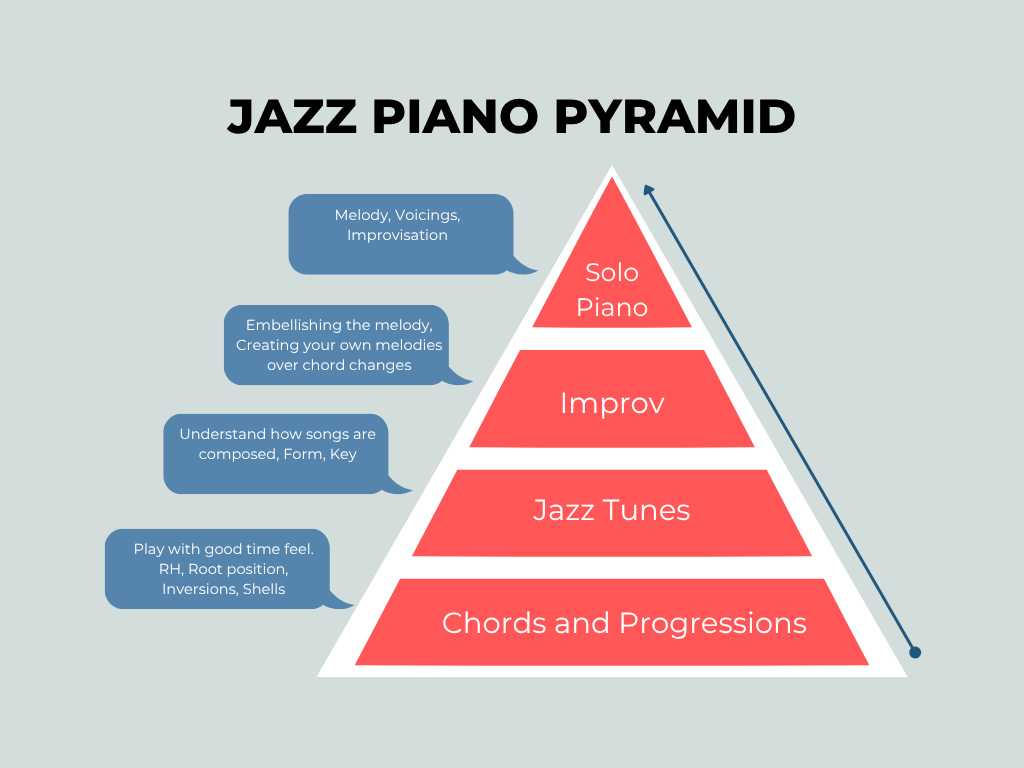
The Real Starting Point: Playing a Role, Not Playing Everything
For most pianists, the ultimate goal is either to play solo piano confidently or to play in a group—supporting the music with harmony, improvising when appropriate, and understanding how everything fits together.
Ironically, solo piano is one of the most demanding forms of jazz playing. Yet it’s often treated as the entry point.
A far more natural place to begin is by learning how to function inside the music—the way a pianist would in a band setting. That means developing the ability to support the harmony, keep solid time, and make the music feel grounded. When this skill is in place, everything else grows more easily from it.
This is why early work in jazz piano should focus on chords and harmonic movement, not on trying to juggle melody, bass, and improvisation all at once.
Jazz as a Skill-Based Language
Jazz isn’t just a collection of tricks or licks.
It’s a language built on patterns, movement, and relationships.
Improvisation works when your hands and ears understand what’s happening harmonically in real time. That doesn’t come from memorising tunes alone—it comes from developing specific, repeatable skills that tunes are built on.
Rather than treating songs as end goals, I use them as training environments. Each tune highlights a small set of harmonic ideas that appear again and again across the jazz repertoire. As those ideas become familiar, your ability to adapt, vary, and respond improves naturally.
Fluency Before Freedom
One of the clearest signs of progress in jazz is flexibility.
Can you change the voicing of the chord you are playing?
Can you substitute that chord with another?
Can you play the song in a different key, tempo, or style without needing to practice it first?
That kind of freedom depends on fluency. To play comfortably in a key, you need more than a scale—you need an instinctive grasp of the chords and how they tend to move. When those patterns are internalised, the music stops feeling like a series of calculations and starts feeling conversational.
This is a slow process, and that’s normal. Jazz fluency develops through repetition, attention, and time spent inside the harmony.
Time as a Foundation, Not an Afterthought
Another layer of the pyramid that’s often underestimated is time.
There is no point in playing the right notes or 'beautiful voicings' without a steady sense of pulse. Playing with a clear sense of time—even with the simplest material—creates confidence and direction.
That’s why structured practice with a steady pulse is essential. It reveals whether a skill is secure or still under construction. I encourage students to always play with other musicians or with a backing track. Over time, your relationship with time becomes less forced and more natural, and the music begins to breathe.
Why This Order Matters
When pianists rush ahead before these foundations are in place, progress becomes inconsistent. Things may work one day and fall apart the next. Confidence depends on circumstances rather than understanding.
The Jazz Piano Pyramid exists to solve this problem.
Each layer supports the next:
Solid time and feel
Physical familiarity with the keyboard
Clear understanding of harmonic function
Gradual development of vocabulary
Confident, expressive playing at the top
When the pyramid is built in this order, learning feels logical instead of overwhelming.
A Different Kind of Progress
This approach isn’t about shortcuts.
It’s about sequence.
Students who follow this path don’t just collect tunes and licks—they develop the ability to understand, adapt, and create. Over time, they stop chasing results and start trusting the process.
And that’s when jazz piano stops feeling mysterious and actually starts feeling possible.
Check out this video from my Jazz Piano Fundamentals Course
Did you like this article? Spread the word!


About me
I’m Owen Chimuka, a jazz pianist and teacher with over a decade of experience helping adult pianists make sense of jazz. My approach focuses on building real musical skills in the right order, so jazz feels clear, practical, and playable—not confusing or overwhelming.
Actionable tips from top musicians
The insights you need to become a real jazz musician.
Jazz Courses

Start Your Jazz Piano Journey Today!
A blog that breaks jazz piano down into clear, practical steps—helping adult pianists build real skills, understand the music, and make steady progress without confusion or guesswork.
Solutions
Clear structure instead of confusion.
Skills built in the right order.
Jazz piano that actually feels playable.


